What We See When We Look
Think you can tell what's made with AI?

I was on the couch sipping coffee a few months ago when I first ran across the contentious painting in my news feed. A soft field of green and violet, abstract water and rippling light. Beneath it, X had attached its provenance label: "Made with AI."
It was posted by SHL0MS, a conceptual artist with a history of provocations. He invited his followers to explain why the image fell short of a real painting, and they duly obliged. The post quickly got over 6.7 million views, and the replies were mostly self-righteous critiques. One dismissed the picture as an "incoherent muddle of greens." Others criticized the flat composition, an absence of intention, and the telltale smearing where a human hand would have been more deliberate.
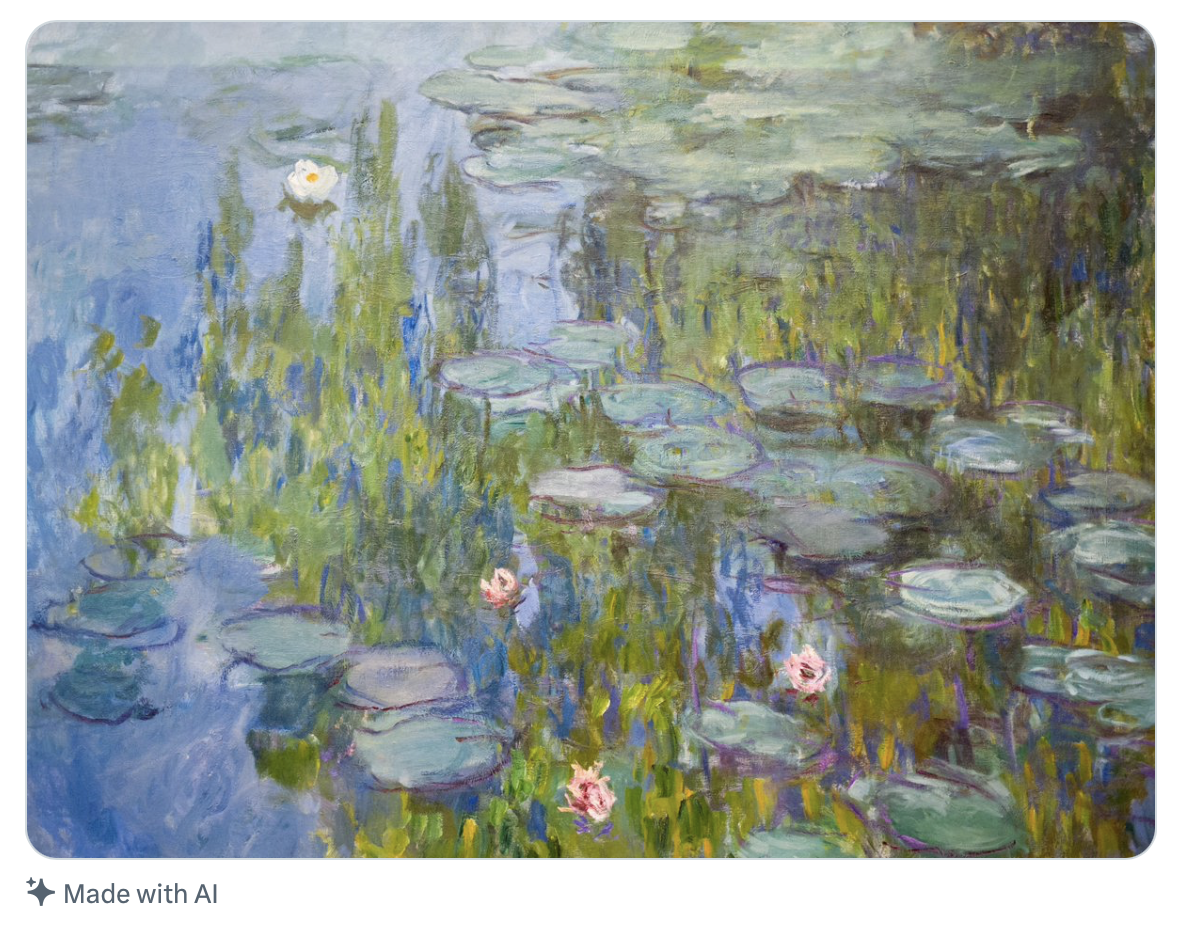
The image was in fact a cropped detail of one of Claude Monet's Water Lilies. The only synthetic thing was the label, applied by X's own systems to a photograph of a painting made a century before image generators existed. When SHL0MS revealed the source, the deletions began within minutes, while the painter Kendric Tonn and the art historian A.V. Marraccini spent the day defending late Monet, in real time, to an audience already deleting its replies.
The stunt was successful in part because it happened just as the anti-AI movement reached a mainstream fever pitch, where "is it AI?" feels like both an answerable question and a damning verdict. The research indicates it isn't quite that simple.
When nobody knows
Blind studies consistently show that most people can't tell the difference. In 2024, researchers Simone Grassini and Mika Koivisto showed people a mix of human and AI artworks without labels; participants couldn't reliably tell them apart and frequently preferred the AI images. And the pattern holds across different media. Deezer reported this spring that 44% of the music uploaded to its platform every day, roughly 75,000 tracks, is fully AI-generated, and 97% of listeners in its survey could not tell those tracks from human ones. In April an AI music act called IngaRose reached No. 1 on the US iTunes chart. It was the latest in a string of synthetic acts to reach the charts over the past year. And in a study peer-reviewed for CHI, a leading human-computer interaction conference, readers who didn't know who wrote what preferred AI-generated prose over passages by expert human writers.
The label does the seeing
Put the label back, though, and things change. A meta-analysis out of Tilburg University, a study pooling dozens of experiments, found that telling people a work is AI-made lowers their ratings of the identical piece, reliably enough to shift what they report about its colour and brightness. The bias runs deep enough to alter basic perception. The researchers suggest that the discrimination may be transitional, comparing it to the early dismissal of photography. In music, the same performance gets rated lower when listeners believe a machine is playing, though one counter-study found pop songs rated higher when labelled AI. The penalty is harshest in genres where we expect a soul behind the sound, and lightest where the production is already assumed to be heavily processed.
One of the strangest results in this research comes from a book published in 1947. Raymond Queneau's Exercises in Style tells one trivial anecdote—a crowded Paris bus, a long-necked young man, a squabble, a button—ninety-nine times over, each in a different style, to demonstrate that the style does most of the work and the story barely matters. Princeton researchers recently used it to test attribution bias: same passage, different byline. Humans favoured identical tellings by 13.7 percentage points when they believed a person wrote them. Then the researchers handed the judging task to AI models. The models' pro-human bias measured 34.3 points, two and a half times stronger than our own! Trained on decades of our writing about authenticity, the machines learned that machine-made means worse, and they apply the lesson to their own kind more harshly than we do.
The evidence doesn't all point the same way. A paper in PNAS found the opposite effect in certain setups, with language models favouring machine-written text when choosing between options. Both effects appear to be real.
A new study in the journal Cognition adds a hopeful wrinkle. Researchers at ETH Zurich used a rapid-response test designed to catch automatic reactions and found no knee-jerk aversion to AI art at all. Teaching participants how image models are trained, about the scraped datasets, and the prompting, shifted their judgment of whether AI art is morally acceptable, especially where money or acclaim was involved, even as their aesthetic ratings remained unchanged. The objection people develop is ethical rather than perceptual. And it's learned, which means it can change.
A tell you need a theorem to see
There are real differences between human and machine work, but not where you'd expect to see them. This year mathematicians reported in PLOS Computational Biology that six masters of abstraction, Rothko, Kandinsky and Pollock among them, share a hidden structural signature: their canvases violate a topological symmetry called Alexander duality, a mathematical balance between painted forms and the space around them, by a strikingly consistent ratio of 0.4. The AI images generated to imitate them don't reproduce that ratio. So there is a tell, but you need a theorem, and a calculator, to see it.
The same study carries a complication though. In the lab, the human paintings won on ratings and gaze time. But when hung in a real gallery, the ratings evened out and visitors gazed at the AI images twice as long. Even a genuine difference, it turns out, depends on context.
In music the structural difference runs both shallower and wider. Researchers Wu and Holmes describe the flood of AI streaming tracks as "algorithmically curated easy listening," music optimized to sit at the median of everything humans have already made. Session musicians have aimed for the median for a hundred years. What's changed is that the median is now shipping 75,000 tracks a day. That's not to say that there isn't novel and creative AI music being made, because there is, but the majority is pretty mid.
Just to be clear it's not like all AI use is undetectable. LinkedIn has been flooded of late with lazy posts and comments rife with structural clichés, made obvious by the repeated language patterns. On Bluesky there's a daily deluge of cheesy images helpfully tagged #aiart by their authors, not as a warning, but as a way to help other AI fans find it. And YouTube is awash in generic generated videos providing questionable information narrated by almost-but-not-quite-convincing narrators. At this point in time the discerning consumer can tell the difference, but that might not last as the technology continues to improve and the models eventually learn to avoid the obvious tells.
Sorting by other means
Even if looking or listening can't settle the question, people still sort by something else: values, and money. Over the course of three weeks in June the major divide played out as a single storyline. On June 2, Martin Scorsese announced he had joined Black Forest Labs, the German company behind the Flux image model, as an adviser. In the announcement video he storyboards a scene from his New York office and places the tool in his own lineage of adopted technology, like the 3D of Hugo, and the de-aging in The Irishman. Cinema is barely 125 years old, he argues, so "we have to be open to how it can evolve." A week later, the Art Directors Guild, the union representing the production designers, illustrators and scenic artists whose crafts use those storyboards, condemned Scorsese and called the move "a betrayal of the collaborative nature of cinema." One of the most revered living directors stood on one side; the craftspeople his films have spent fifty years honouring on the other. Then on June 22, Google DeepMind invested roughly $75 million into A24. This was the first time Alphabet has taken a stake in a film studio, and the boycott calls started the same day. Wired's headline: "A24 Knows You're Mad." Beneath the anger sits a number: an analysis by CVL Economics puts about 118,500 US film, television and animation jobs at risk from AI.
Literary institutions got a similar test a few weeks earlier. In May, Granta published the five winners of the Commonwealth Short Story Prize. Within days, an AI-detection tool flagged the winning story as machine-generated, then flagged more of the winners, and the foundation behind the prize admitted it had no AI policy and found itself re-examining a prize it had already handed out, with the literary world watching. Whatever the truth about any single story, the episode showed what the research already predicted. A literary prize is judgment made official, taste with a budget and a ceremony, and when the ability to tell turns out to be unreliable, the institutions built on telling lose their grip.
The AI-embracing side includes people who rarely make the headlines. Mind's Eye is a free tool that lets people with motor neurone disease, which progressively takes away movement and speech, paint using only their eyes, with gaze tracking on the front, and AI image generation on the back-end. One of its testers, Mike Small, lost his speech to the disease and got a visual voice back using this technology. "They say a picture says a thousand words," he wrote. "How about a million?"
Many people straddle both camps. Matthew McConaughey trademarked his own face and voice this year even while investing in ElevenLabs, the AI voice company, thereby protecting himself and buying in at the same time. My friend Ola, whose AI music practice I wrote about last summer, calls the technology "a completely new kind of instrument" and describes herself, in the same breath, as amazed and terrified.
Three paths
Photography went through this exact phase. For its first decades, ambitious photographers shot soft-focus, painterly images, a movement called pictorialism, because painting was what art was understood to look like. The medium grew up when it stopped imitating, and let a photograph be sharp, mechanical, and unmistakably itself. A similar story played out with electronic music. Once derided as fake and mechanical, the use of synthesizers and samplers eventually became widely accepted once creative adopters began to forge new sounds and develop new genres that didn't try to imitate the past.
That same progression is happening now with AI, in three distinct ways. First, the technology is disappearing into ordinary production: Spotify and Universal signed licensing agreements in May covering fan-made covers and remixes, signalling that AI use is headed for the same unremarkable status as the synthesizer. Second, human-made is becoming a premium label: the Authors Guild now offers a "Human Authored" certification, and music-streaming service Tidal labels and restricts AI music on its platform. The third way belongs to the artists who foreground the synthetic instead of disguising it.
Holly Herndon and Mat Dryhurst have been on that path for a decade. They released Holly+, a clone of Herndon's voice that anyone can use, with profits shared. They built Public Diffusion, an image model trained only on public-domain pictures. They founded Spawning, a startup that ran an opt-out registry for artists who wanted their work kept out of training sets; it shut down in 2025, too small for the AI companies to build standards on and too conciliatory for the artists who resented any deal with the industry at all. The Atlantic's August cover story treats the pair as a preview of where this is all going, and their response to a decade inside the machinery has been to keep making more art. "There's a lot that you can't AI your way out of," Herndon says.
The avant-garde survives in that last lane, and the artisanal survives in the certified-human one. What gets squeezed is the competent middle, the work whose main value was only passing at best. The ETH Zurich finding offers an optimistic take on all this: the resistance is learned, which makes it a phase we are teaching ourselves through, the way we once taught ourselves that a photograph could be art. Passing is what a medium does in its anxious adolescence. Maturity is when it stops trying to be something it's not.
My coffee had gone cold by the time I found the original uncropped Monet. At full size the muddle of greens resolves into water and light and the same subtle interplay that stopped my scroll in the first place. Millions of people looked at it for two seconds and believed what they wanted to see, rather than what it was. The authors who eventually deleted their replies deserve some sympathy. They were basing their discrimination on a skill no one reliably possesses, at a point in time that keeps insisting we should. The labels will keep telling us what we're seeing, or they won't. What we can do is look, and have some patience and appreciation for the people making things, whether with brushes or with AI, and acknowledge we're in the middle of a phase whose end none of us can see.
Research and editing assistance provided by Claude Fable 5. Feature image generated with Midjourney v8.2 Preview.