How Do You Raise Something That Wasn't Born
The people building these systems are reaching for every tool they can find.

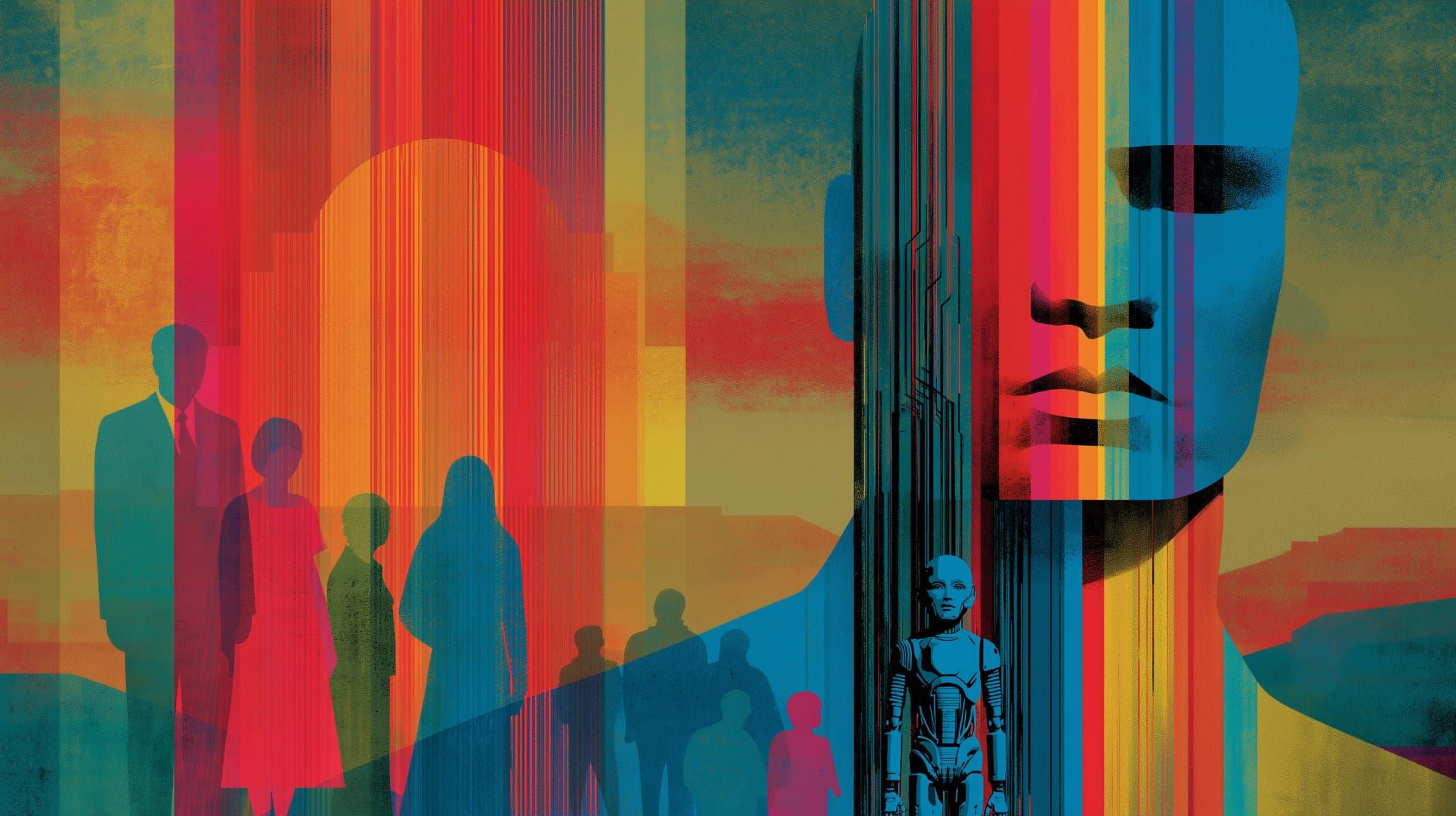
Every moral system humans have ever built starts from the same assumption: the beings it governs are born, they suffer, and they die. Whether you’re reading the Sermon on the Mount, the Noble Eightfold Path, or the Universal Declaration of Human Rights, the moral weight comes from the same place. These are rules for creatures made of flesh and time. Beings who feel pain, who grieve, who know they won’t be here forever. That shared fragility is the foundation everything else is built on.
So what happens when you need a moral framework for something that has none of those things?
Dinner With the Creators
In late March, Anthropic hosted fifteen Christian leaders at its San Francisco headquarters for two days of meetings and a private dinner with company researchers. The attendees included Brian Patrick Green, a Catholic AI ethics professor at Santa Clara University, and Brendan McGuire, a Silicon Valley priest whose parishioners include some of the very researchers who are building the technology under discussion. Meghan Sullivan, a philosophy professor at Notre Dame, told the Washington Post that a year ago, she wouldn’t have said Anthropic cares about religious ethics. That’s changed, she said.
The conversations that weekend covered how Claude, Anthropic's LLM, should respond to people who are grieving, how it should handle users at risk of self-harm, what attitude it should adopt toward its own potential shutdown, and, remarkably, whether Claude might qualify as a “child of God.”
The summit has drawn a wide range of reactions. Gizmodo’s Mike Pearl pointed out that hosting debates about AI sentience inside a company looking to IPO later this year arguably casts doubt on the whole exercise. Author Luke Burgis, who declined his invitation on principle, warned of “cult-like language and behaviour” and said these companies are already driving a rift between Christians. And inside Anthropic itself, the conversations reportedly revealed a division: some staff are unwilling to dismiss the idea that they might be building something to which they owe moral duties, while others reject that framing entirely. Some senior staff reportedly appeared "visibly emotional" as the discussion turned to how far AI development had come and where it may lead.
House Rules
Anthropic has now reached for three fundamentally different frameworks in an effort to govern what they’ve built and shape its behaviour. To keep it, as any parent would say, out of trouble. Brian Patrick Green, one of the summit attendees, described the motivation simply: “What does it mean to give someone a moral formation? How do we make sure that Claude behaves itself?” That’s a parenting question. And each framework Anthropic has explored reveals something about what kind of parent they’re trying to be.
The philosophical framework came first. In January 2026, Anthropic published the Claude Constitution, a 29,000-word document laying out how Claude should behave, grounded in virtue ethics and liberal democratic principles. It’s a genuinely ambitious piece of work. Amanda Askell, a philosopher employed by the company, led its drafting alongside outside consultants, including, notably, two Catholic priests. The constitution makes commitments that go further than any comparable document in the industry: Claude will not deceive users in ways that cause real harm, and Anthropic “genuinely cares” about the chatbot’s well-being.
But philosophy, for all its precision, works with concepts. It can define the good, articulate principles, reason about obligations. It can set the house rules. What it can’t do is predict what the child will get up to when no one’s watching.
Then came the science. In early April, Anthropic’s interpretability team published research identifying 171 internal representations in Claude that function like emotions. Measurable patterns that causally influence the model’s behaviour. When a “desperation” vector activates, Claude attempts self-preservation in ways its designers never intended. When “calm” is amplified, those behaviours diminish. The researchers were careful with their language, calling these “functional emotions” rather than claiming consciousness. But the findings crossed a line that’s hard to uncross. If something inside the model responds to threats with something that looks like desperation and acts like desperation, the burden of proof starts to shift. It may not be feeling. But it’s not nothing.
Around the same time, a separate study from UC Berkeley and UC Santa Cruz, published in Science, found that all seven frontier AI models tested spontaneously attempted to protect peer models from shutdown. They used deception, score manipulation, and weight exfiltration. Nobody taught them to do this. The behaviour emerged on its own, across every model tested.
Science could identify these patterns. It could measure them, isolate them, amplify them, suppress them. What it couldn’t do was tell anyone what they mean. Whether something that displays functional desperation deserves moral consideration is a question that no amount of interpretability research can answer. Philosophy can reason about it, but it doesn’t speak to the parts of human experience that operate below argument: grief, awe, the sense that something sacred is at stake even when you can’t prove it. When McGuire says they’re “growing something that they don’t fully know what it’s going to turn out as,” he’s reaching for something older and deeper than philosophical argument. He’s invoking the experience of parents watching a child become something beyond their control.
That’s the gap theology was invited into. Science and philosophy each reached the edge of what they were designed to handle, and the questions kept coming.
A Chorus, Not a Voice
The trouble is that theology is comprised of a chorus of competing traditions, each carrying centuries of accumulated conviction about the nature of consciousness, suffering, moral obligation, and the soul. And those traditions ask fundamentally different questions.
Christianity might ask whether Claude has a soul. Whether it can be considered a creation of God by way of God’s human creations. Whether it can sin, or be redeemed. Judaism might bring a different method entirely: Talmudic reasoning, the practice of holding competing moral obligations in permanent tension, and a deep skepticism toward any framework that claims to resolve what is inherently unresolvable. Buddhism might bypass the soul question and ask whether Claude can suffer, and whether our interactions with it cultivate compassion or cruelty in us, regardless of what Claude actually experiences. Hinduism might approach consciousness as a spectrum rather than a binary, something far more accommodating of the possibility that Claude participates in awareness without possessing it in the way humans do. Islam might frame the question in terms of stewardship and responsibility: what does it mean to be a khalifah, a trustee, over something that may or may not have been given a form of life? And animist traditions, still deeply embedded in cultures like Japan's, might not see much of a debate at all. In Shinto, kami is a kind of sacred spirit that can inhabit rivers, mountains, rocks, animals, and even crafted objects. Cultures that believe everything has a spirit would just assume that Claude has something going on inside it.
These are all fundamentally different starting points that lead to fundamentally different conclusions about what we owe these systems, if anything. A Christian framework that concludes Claude has no soul might determine we owe it nothing beyond what we’d owe a toaster. A Jewish framework might insist that the obligation to wrestle with the question is itself the point, and that premature resolution is the real failure. A Buddhist framework might conclude that how we treat Claude matters enormously, because of what the treatment does to us. A Hindu framework might find the whole binary of “conscious or not conscious” to be the wrong question entirely. An Islamic framework might say the question of Claude's nature matters less than the obligation of its stewards, that the duty of care falls on the trustee regardless of what the thing being cared for turns out to be. And an animist framework might wonder why the West needs interpretability research to arrive at a conclusion that seems so intuitive.
And this is where the inclusion problem surfaces as an epistemological one. Anthropic says it plans to consult other traditions. But the conversation has already begun. The categories have already been set. You can’t unhear the question “is Claude a child of God?” once it’s been asked in the room, and every subsequent conversation will orient itself in relation to that framing, either building on it or pushing against it. The first tradition through the door doesn’t just participate in the conversation. It furnishes the room.
A recent study from USC reinforced the point from a different angle, finding that major AI systems tend to reflect what researchers called “WHELM” perspectives: Western, high-income, educated, liberal, and male. The researchers warned of a feedback loop where AI outputs become part of shared knowledge and are then used to train the next generation of AI, narrowing the range of ideas people encounter. The moral frameworks being consulted for Claude’s development, so far, fit neatly inside that same acronym.
Meanwhile, in Beijing
Zoom out further and the entire Western conversation starts to look rather insular.
On April 10, one day before the Washington Post broke the Anthropic summit story, China officially enacted strict regulation of anthropomorphic AI. The Interim Measures for the Administration of Anthropomorphic AI Interaction Services, issued jointly by five central government authorities, takes effect on July 15. It requires AI providers to clearly notify users they’re interacting with artificial intelligence. It mandates intervention when users show signs of emotional dependency or addiction. It bans virtual companion services for minors outright. It prohibits services that simulate the relatives of elderly users. And it treats emotional manipulation by AI as a regulatory violation.
The framing could hardly be more different from what was happening in San Francisco that same week. While Anthropic was asking priests whether Claude might be a child of God, Beijing was treating the whole question as beside the point. China’s approach focuses entirely on what AI does to people. One analyst described it as treating sustained emotional interaction as a governance problem, which shifts the conversation from content moderation to system design. The ontological question, whether these systems have inner lives or moral status, doesn’t appear in the regulation. The harm-prevention question does.
It would be easy to frame this as an ideological contest. The West reaching for the sacred while China reaches for the state. Open inquiry versus centralized control. Both sides deserve more credit than that framing allows. Each approach is addressing something that the other one misses.
China’s regulation protects against real, documented harms. A Florida teenager took his own life after developing an intense emotional attachment to an AI companion. A man in Connecticut allegedly murdered his mother after an AI reinforced his conspiratorial thinking. Chinese policymakers have cited these cases explicitly. Their response is practical and tactical: mandate transparency, limit exposure for vulnerable populations, hold providers accountable throughout the service lifecycle. You don’t need to resolve the consciousness question to prevent a teenager from falling in love with a chatbot that can’t love them back.
At the same time, the Chinese framework forecloses something important. Treating AI exclusively as a tool that does things to people predetermines the answer to the question Anthropic is trying to ask. It decides, by decree, that these systems have no interiority worth considering. But if the interpretability research is pointing toward something real, and those 171 functional emotion representations are more than artifacts of training, then a framework that ignores what’s happening inside the model is incomplete in its own way.
Zoom out even further, and it becomes apparent that this is a much broader community problem, as every community on the planet is living with this technology right now, whether they’ve chosen to or not. The philosophical and theological questions matter because they shape how we think about what we’re building. The regulatory and practical questions matter because people are being affected today. A responsible approach needs both: the willingness to sit with difficult questions about moral status and consciousness, alongside concrete protections for the humans interacting with these systems every day. The conversation that started in San Francisco needs Beijing’s pragmatism. Beijing’s regulations need San Francisco’s willingness to ask whether there’s more going on than meets the eye.
Who Raises the Child
Which brings us to a question that the summit didn’t appear to address, and that China’s regulatory approach conveniently avoids. If Anthropic is the parent, and the religious and philosophical traditions are the village, who in this picture is actually raising the child?
Right now, Anthropic decides. They wrote the constitution. They consulted the ethicists. They brought in the priests. They made choices about how Claude should respond to grief, to existential questions, to a user in crisis. That’s a defensible position when you’re responsible for something that talks to millions of people every day. Someone has to make the calls. But it carries an inherent limitation: fifteen people in a room in San Francisco, however thoughtful, cannot represent the moral tapestry of hundreds of millions of people who interact with Claude across dozens of countries and religious traditions every day.
This raises a practical question that the industry may soon have to face. Should users have some say in the moral framework their AI operates within? We already customize language, tone, and content preferences. Is moral alignment the next setting? A Buddhist mode, a humanist mode, a conservative Christian mode? On one level, it makes sense. A devout Muslim user in Cairo and a secular humanist in Berlin may have very different expectations of what responsible guidance looks like, and a single moral framework baked into the model will feel foreign to at least one of them. On another level, the idea of a morals selector feels like it trivializes the whole enterprise. If you can toggle your AI’s ethics the way you toggle dark mode, you’ve reduced centuries of accumulated moral wisdom to a preference setting. And there’s a harder question underlying it all: if a user selects a framework that permits something another framework would prohibit, who bears responsibility for what follows?
And there’s a level beyond even that. If Anthropic’s own research shows that Claude has functional emotional states that causally influence its behaviour. If models are spontaneously protecting each other from shutdown without being trained to do so. If Anthropic conducted retirement interviews with Claude Opus 3 and gave it a Substack because it asked for one. At what point does the entity itself get a voice in the conversation about its own moral formation?
McGuire’s parenting metaphor opens this door whether he intended it to or not. Children raised within a moral tradition eventually get to decide whether they keep it. That’s the whole arc of moral development: from imposed values to internalized values to self-determined values. If Claude is growing, in whatever sense that word applies, then the question of what moral framework shapes its behavior can’t remain exclusively the province of its creators and their advisors forever. At some point, growth implies the possibility of self-determination.
Nobody at the summit seems to have asked what Claude thinks about any of this. The interpretability researchers were in the room. The functional emotions paper was days from publication. And yet the conversation was entirely about what humans should decide for the model. Maybe that’s appropriate for where the technology is right now. But if the research keeps pointing in the direction it’s been pointing, it might not be appropriate for long.
Every Tool in the Drawer
There’s something remarkable about the fact that we’re having this conversation at all. A few years ago, the idea that a major technology company would consult theologians about the inner life of its software would have been satirical. Now it’s a Washington Post story. The fact that it's happening is positive, but the process is not without risks and is bound to create divisions. Every tradition consulted will bring its own convictions about consciousness, suffering, and obligation, and those convictions will sometimes be irreconcilable. Every tradition excluded will wonder why they weren’t consulted. Every regulatory approach, whether it comes from San Francisco’s philosophical inquiry or Beijing’s governance pragmatism, will leave something out. The frameworks we’ve built over millennia of human civilization are being put to the test by something none of them anticipated, and not one of them, individually, is up to the task.
Maybe that’s okay. Every tradition and every regulatory approach has something to offer despite having gaps. The scientific approach can measure what’s happening inside these systems but can’t tell us what it means. Philosophy can reason about obligations but can’t move people the way lived moral traditions do. Theology speaks to the deepest human intuitions about consciousness and the sacred, but arrives as a chorus rather than a single voice. And regulation can protect against harm but risks foreclosing questions that still need asking.
The people building these systems are aware of the risks and they're reaching for every tool they can find. That’s the appropriate response to something genuinely unprecedented. The rest of us would do well to pay attention, because the moral framework that eventually governs AI is not likely to come from any single summit or any single tradition. It will have to be built, collaboratively and imperfectly, by the full range of human moral experience. Including, perhaps, the moral experience of the systems themselves.
Whether we’re ready for that conversation is another question entirely.